


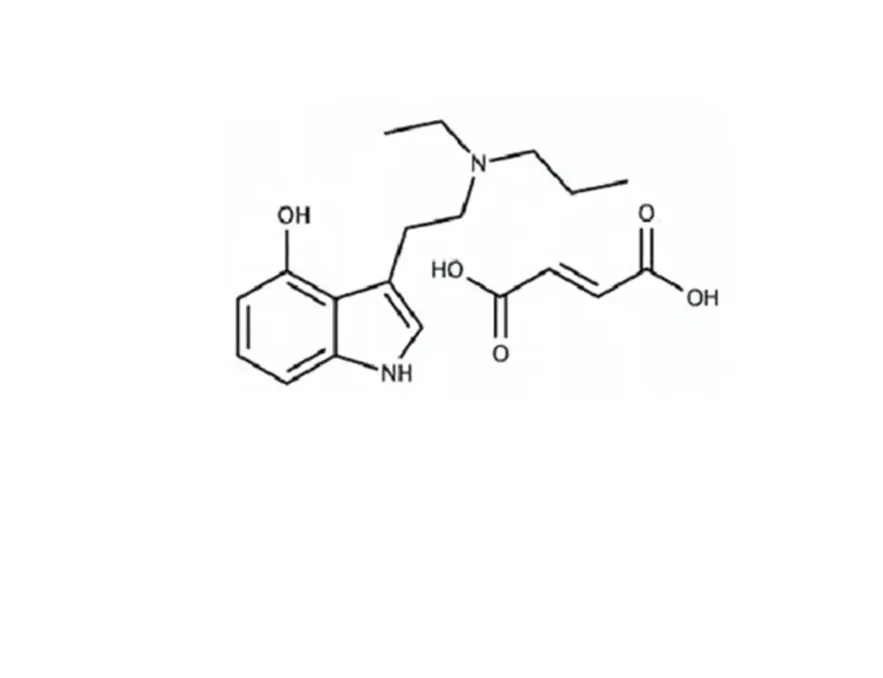
Fumaran 4-HO-EPT
Właściwości fumaranu 4-HO-EPT
Synonim: Fumaran 4-hydroksy-N-etylo-N-propylotryptaminy
CAS Numer: 63097-26-7
Formuła: 3-[2-(propyl(ethyl)amino)ethyl]-1H-indole-4-ol fumarate
Masa molowa: 362,4 g/mol
Czystość: >97%
€23.50 – €336.00Zakres cen: od €23.50 do €336.00
* Informacje na tej stronie stanowią podsumowanie i nie obejmują wszystkich dostępnych informacji na temat tego leku. Nie obejmują one wszystkich możliwych zastosowań, sposobów użycia, środków ostrożności, interakcji z innymi lekami ani działań niepożądanych i nie zastępują wiedzy i osądu lekarza.
4-HO-EPT Fumarate – Pharmaceutical Grade Research Chemical
Nazwa produktu: 4-HO-EPT Fumarate
Nazwa chemiczna: 4-hydroxy-N-ethyl-N-propyltryptamine (fumarate salt)
Wzór cząsteczkowy: C15H24N2O C4H4O4
Masa cząsteczkowa: ~376.43 g/mol (including fumarate)
Czystość: ≥ 98% (certified by HPLC and NMR analysis)
Forma fizyczna: Fine white to light cream colored powder
Opakowanie: Airtight container with laboratory label
What is 4-HO-EPT Fumarate?
4-HO-EPT is a rare tryptamine derivative belonging to the class of serotonergic psychedelics. It is chemically related to psilocybin and 4-HO-MET, but has unique pharmacological properties due to the ethyl and propyl groups on the amine nitrogen. In its fumarate form, this substance is more soluble and chemically more stable for long-term storage.
Applications of 4-HO-EPT
For forensic, analytical, or in vitro use only. Not for human consumption!
- Neurochemical research: Interaction with 5-HT2A receptors
- Structural pharmacological comparison study
- Binding studies and receptor profiling
- Cognitive modeling in laboratories
- Stability testing and crystallographic analysis
Advantages
- High purity (≥98%) suitable for reliable experiments
- Unique binding profile for research into serotonergic mechanisms
- Stable as fumarate – longer shelf life than the free base salt
- Lesser-known molecule , interesting for groundbreaking research
Disadvantages and Risks
- Limited scientific research available – effects largely anecdotal
- No approved medical use
- Risk of misuse or confusion with related substances
- Sensitive to oxidation when exposed to air and light
- Legal status unclear in some countries/regions
Recommended Research Use
- Dosage for in vitro simulations: 0.5 – 2 mg per reaction
- Rozpuszczalnik: Ethanol or sterile aqueous solution, depending on the intended use
- Storage: Cool (2-8°C), dry, light-free
- pH stability: Stable between pH 5.5 – 7.5
Lab Analysis & Reporting
HPLC data:
- Retention time: 7.91 min
- Purity: 98.43%
NMR profile (1H-NMR, D2O):
- Aromatic protons: 6.89 – 7.20 ppm
- Aliphatic chain: 1.02 – 3.45 ppm
Mass spectrometry (MS):
- [M+H]+ peak at m/z 261 (free base)
Instructions for use (for research purposes)
- Use an accurate analytical balance (0.001g accuracy).
- Always wear protective clothing, gloves and glasses.
- Dissolve in suitable solvent under laminar flow hood.
- Close airtight after use and label clearly.
- Record all parameters and results in your lab notebook.
Często zadawane pytania (FAQ)
Is 4-HO-EPT legal in the Netherlands or Belgium?
Its legal status is not explicitly defined. It may fall under the analogues legislation or the Medicines Act, depending on interpretation. Use only for authorized research.
What’s the difference between 4-HO-EPT and psilocybin?
Both are tryptamines, but 4-HO-EPT has a synthetic ethyl-propyl structure instead of a phosphate group like psilocybin, resulting in differences in pharmacokinetics.
Can this substance be used orally?
No. 4-HO-EPT is intended for laboratory testing only and nie for human consumption.
How do I store this product optimally?
In a dark, dry place at temperatures between 2°C and 8°C. Avoid contact with air.
Is the product stabilized as a fumarate?
Yes, the fumarate version increases stability compared to the free base salt, especially during long-term storage.
Important Warning
4-HO-EPT Fumarate is intended for scientific analysis only . Use outside of laboratory conditions can be life-threatening . Possession or use of this substance outside of authorized research may be punishable by law.




 PL
PL  NL
NL  DE
DE  PT
PT  FR
FR  ES
ES  IT
IT  CS
CS  SK
SK  RU
RU  ZH
ZH  EN
EN  NL_BE
NL_BE  IS
IS  NB
NB  NN
NN  SV
SV  DA
DA  DE_AT
DE_AT  SL
SL  TR
TR  FI
FI  AR
AR  ET
ET  FR_BE
FR_BE  HR
HR